The echo chamber.
A single model has no one to push back. Frame a question one way and it agrees. Frame it the other way and it agrees again. Logical gaps go uncaught; selection bias quietly compounds.
 Brainstorming
Replace the single AI assistant with a panel of AI advisors who debate, verify, and balance one another. Compose your own digital board, set a topic, and let them deliberate — with you presiding.
Anyone who has used ChatGPT or Claude for serious work has hit the same three walls. They aren't bugs in any one model — they're structural limits of asking one voice to play every role.
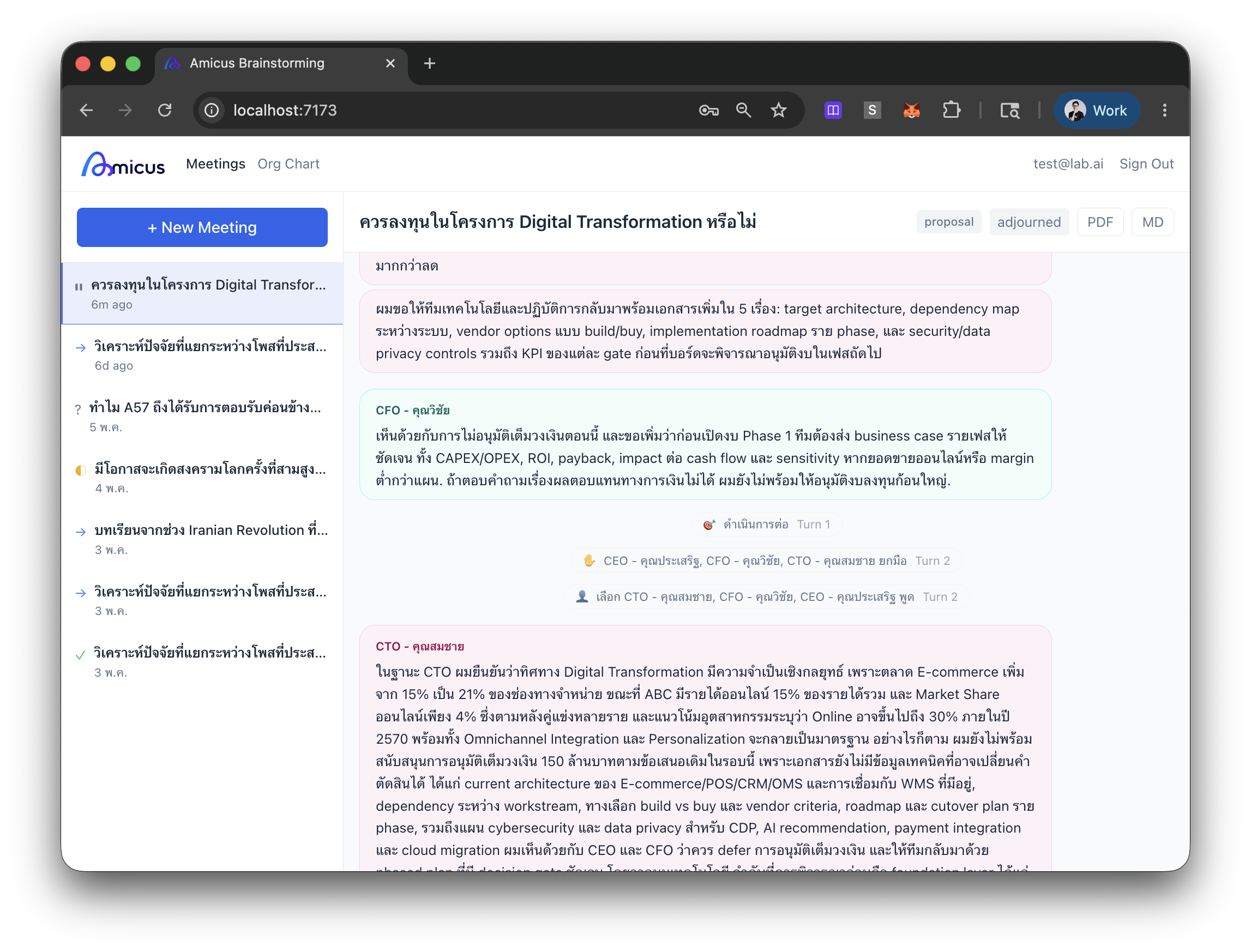
A single model has no one to push back. Frame a question one way and it agrees. Frame it the other way and it agrees again. Logical gaps go uncaught; selection bias quietly compounds.
The model speaks with full confidence even when wrong. There's no built-in mechanism to verify a claim — you're left fact-checking the fact-checker.
Most answers stop at the conventional take. Trade-offs that require holding two opposing views in tension simultaneously rarely emerge from one model speaking to itself.
The cost shows up the same way every time: decisions made on outputs with hidden blind spots, time burnt re-prompting from different angles to manufacture diversity that doesn't really exist — or giving up on AI for important work entirely.
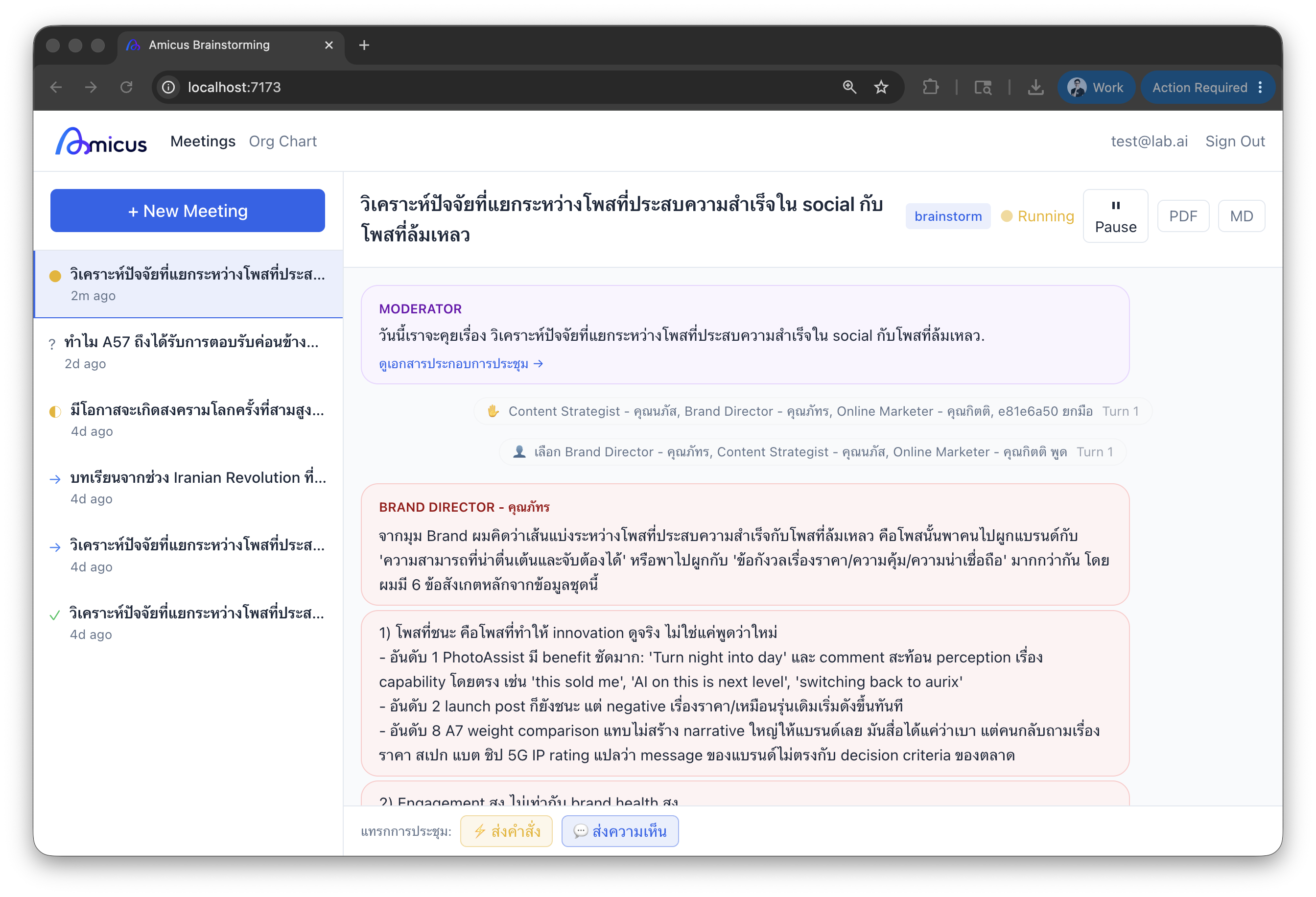
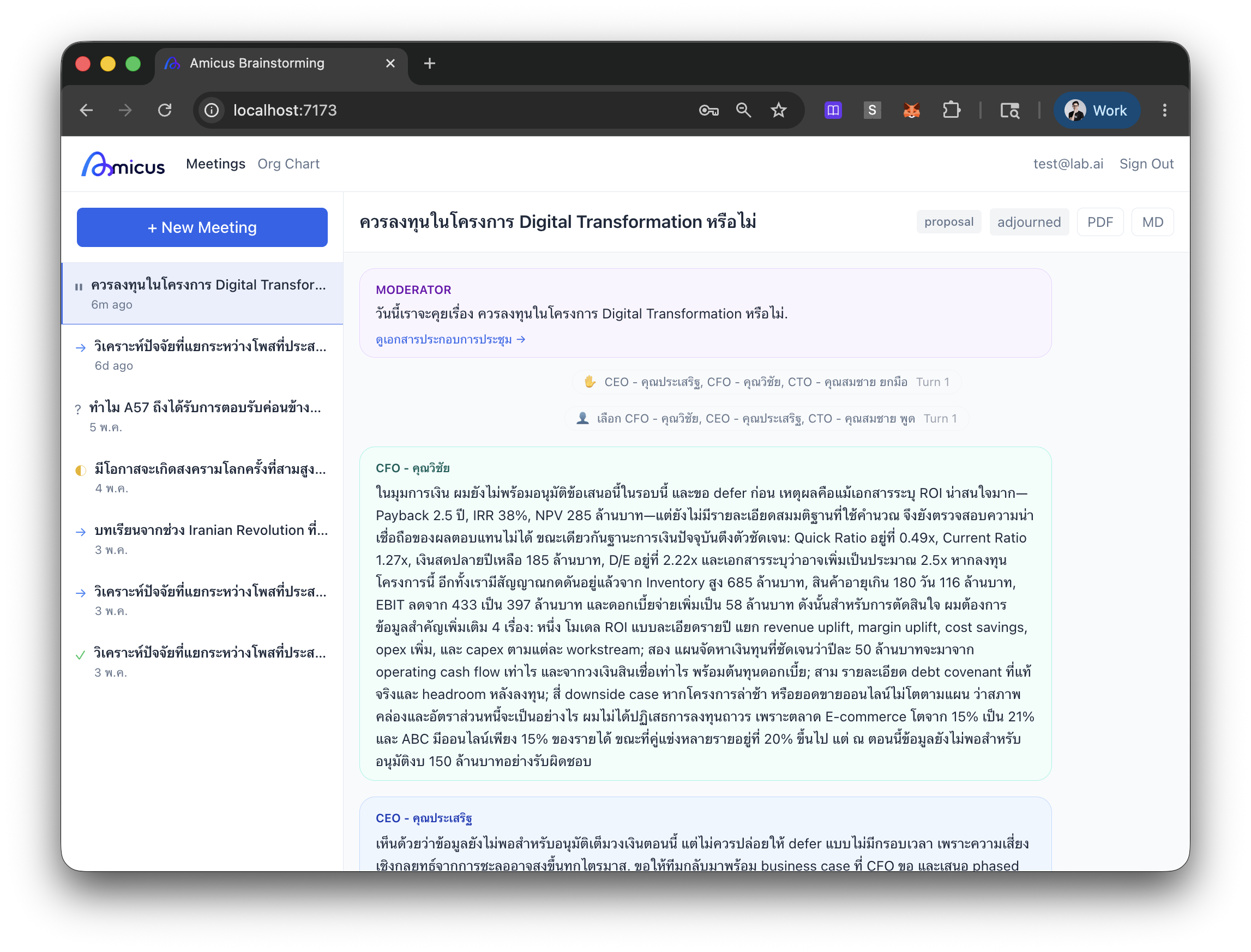
You sign in. Set a topic. Pick a mode — Brainstorm for exploration or Proposal for a decision. Choose the agents who should be in the room. Press Start. From there the meeting runs on its own — agents raise hands, take turns speaking, respond to each other, and converge on a synthesis or a vote. You watch live, step in to redirect or contribute, pause at will, and walk away with a polished document when it's done.
Every meeting follows a rhythm — a state machine that gives the conversation phases, prevents collapse into noise, and makes verification a built-in step rather than an afterthought.
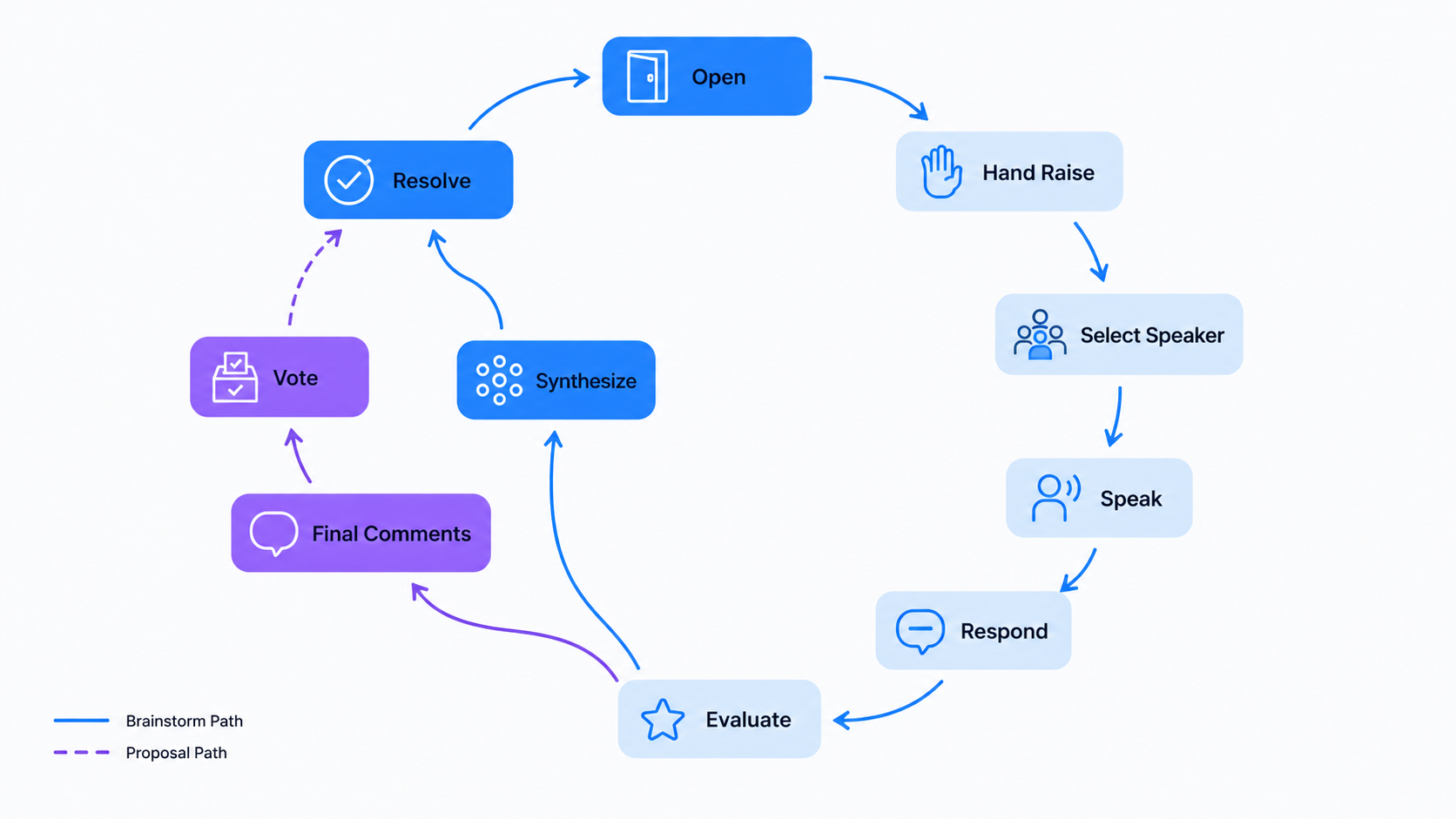
The Moderator opens the session, frames the topic, and invites the panel to engage.
Each participant decides whether they have something worth saying this round, and signals what they intend to contribute.
The Moderator picks who goes next — weighing relevance, fairness, and speaking history so no single voice dominates.
The chosen participant delivers a full statement through the lens of their expertise and personality.
Other participants reply. Per-participant response limits keep the floor balanced and prevent runaway debate.
The Moderator decides where the meeting goes from here — continue exploring, call for closing comments, move to a vote, or defer for more information.
Every participant gives a closing statement before voting — so every voice stakes a position on the record.
Either a structured vote with reasoned positions (Proposal), or a synthesized brief covering summary, findings, and open questions (Brainstorm).
The outcome is recorded. The meeting is sealed and exportable.
Amicus separates open inquiry from binding decision-making, so each gets the right ending: a synthesized brief or a recorded vote.
Best for — strategy work, market exploration, case analysis, idea generation.
Best for — go/no-go decisions, budget approvals, choosing between options, policy calls.
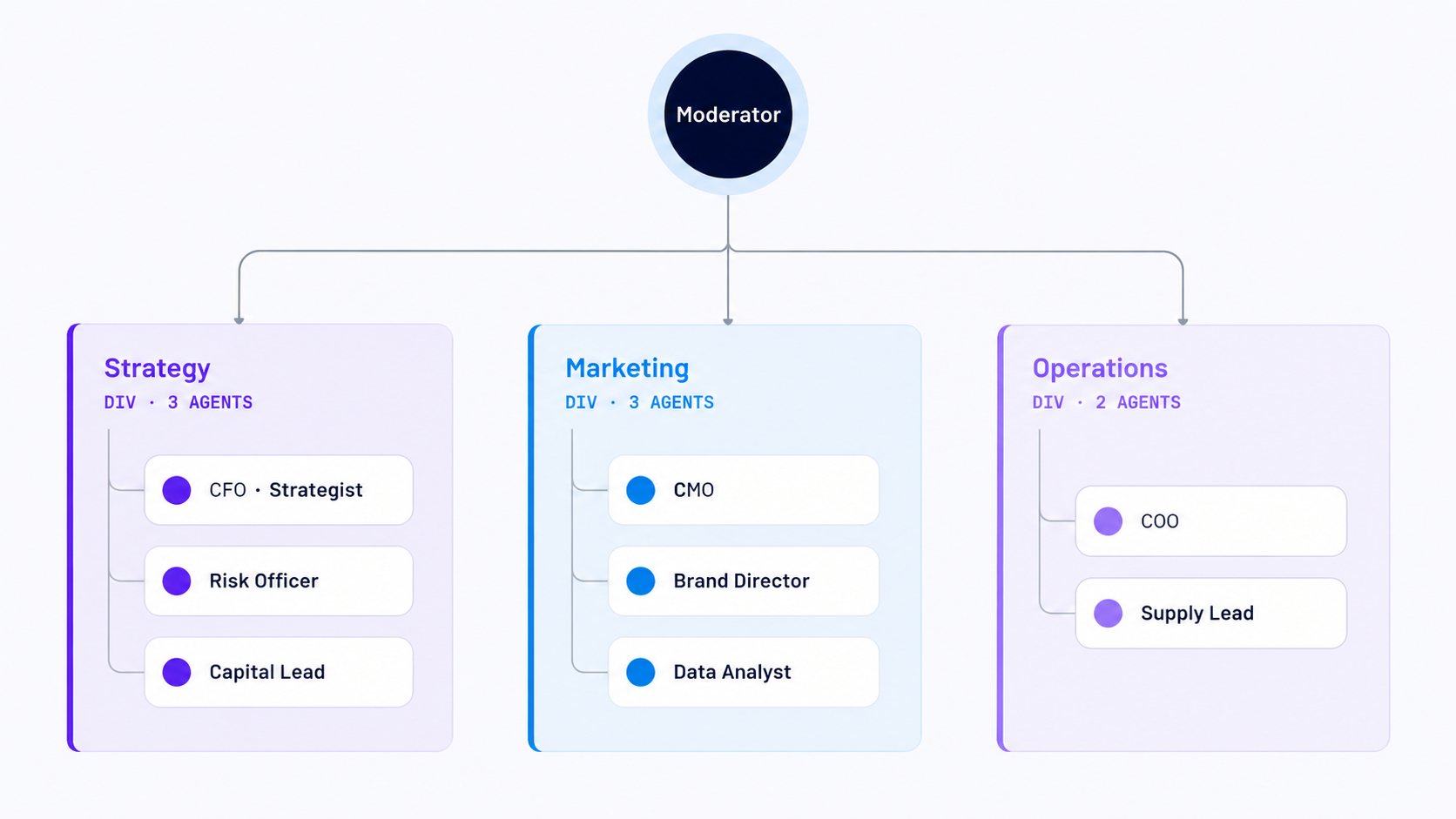
The center of Amicus is not a model — it's a swarm of AI agents you assemble. Each agent carries a distinct role, expertise, and stance, and the whole team is organized exactly the way you'd structure a real one: as an org chart. When you open a meeting, you don't consult the AI. You convene a team.
Inside each agent — a small set of fields that shapes how they think, what they're asked, and how they speak.
Every agent is defined across four dimensions:
A built-in Field Wizard drafts each field for you. Type a name and a one-line role; the system proposes coherent text for every dimension. You edit from a draft instead of staring at a blank box.
Agents are reusable across meetings. Build them once, deploy them anywhere. Your panel grows with you.
A meeting in progress is a meeting you can shape. Amicus offers two distinct ways to step in — each with its own authority — and both run asynchronously, so the room never stops to wait for you, and you never have to wait for it.
An override-level command. Every agent in the room treats it as
binding — no negotiation, no debate. The directive appears in the
transcript marked [Meeting Director] with the highest
priority in the room.
"Stop discussing cost — move to risk."
"Call the vote now."
"Synthesize what you have."
You join the meeting as an additional participant. Agents read
your message, reference it, respond to it. A · human
suffix is attached to your name so agents recognize they're
addressing a real person — distinct from another AI.
"Khun Ran · Founder — I'd weight cash runway above growth this quarter."
Real thinking takes time. A serious meeting may run for an hour or more, and your day rarely cooperates. Amicus is built for this.
The system halts at the next clean phase boundary — never mid-thought — so checkpoints stay coherent. Every piece of state is preserved exactly. Close the browser. Go to dinner. Sleep on it.
The meeting reloads from its checkpoint. Agents remember the conversation in full. Continuity is total — there is no "second take" or context loss.
If anything fails mid-meeting, the next worker that comes online takes over and restores the session automatically. You don't lift a finger.
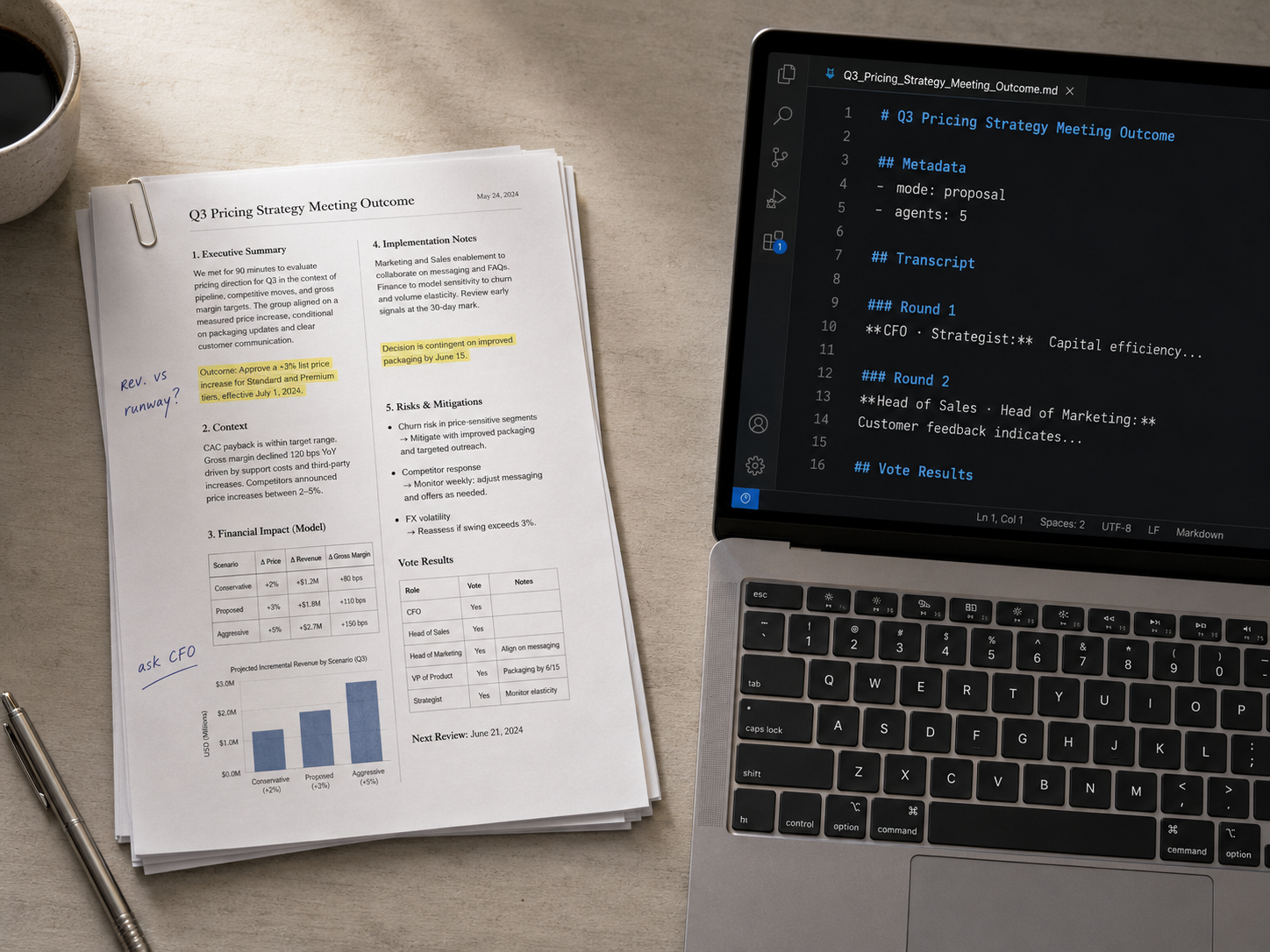
Every completed meeting becomes a document that flows into whatever process needs it next. The output of an Amicus session does not stay trapped in the system.
You don't need to know how it works under the hood, but you should know that it doesn't lose your work. Three quiet guarantees.
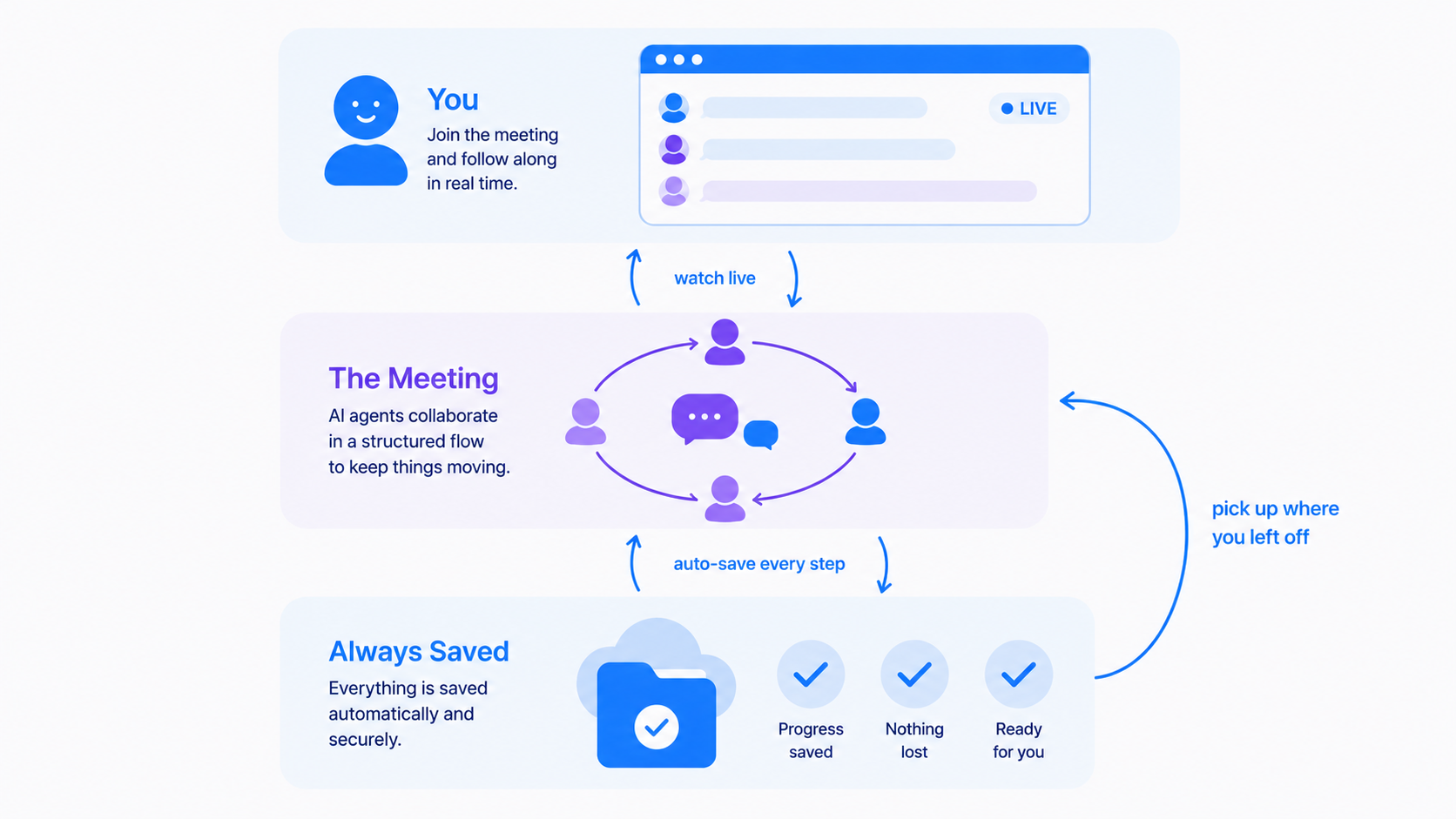
When you press Start, the meeting moves onto its own engine — independent of your browser. Close the tab, switch networks, restart your laptop. The room keeps thinking.
Each message, each vote, each phase transition is written to durable storage the moment it occurs. There's no "save" button, no "did it autosave?" anxiety. Long deliberations can pause and resume with full continuity, even days apart.
If the system stumbles mid-conversation, the next available engine takes over from the last saved checkpoint and continues the meeting from exactly where it left off. The agents don't forget. You don't have to start over.
The result is what every serious tool should feel like: quiet infrastructure. You think about the decision; the system takes care of the rest.
It's AIs designed to disagree productively. Every persona is constructed with a distinct stance, expertise, and lens. When they share a room, verification, balance, and friction emerge automatically — the same dynamic that makes a real boardroom more valuable than a single advisor.
| Tool | Where the answer comes from | How it gets verified |
|---|---|---|
| ChatGPT / Claude | A single AI | You verify it yourself |
| AI search (Perplexity, etc.) | A single AI with citations | Citations help — but the reasoning is still single-perspective |
| Side-by-side multi-LLM | Several AIs answering the same prompt | You compare and reconcile manually |
| Amicus Brainstorming | Multiple AIs deliberating together | The agents verify each other; you preside |
Strategic decisions, scenario planning with diverse advisors on demand, and pre-mortem reviews of plans before you commit.
Synthesize long-form material with a panel of specialists. Stress-test recommendations before client delivery.
Campaign brainstorming with distinct functional voices (CMO, brand, data). Feature reviews from user, business, and engineering vantage points.
Sector and company analysis from multiple angles. Dedicated agents that exist to challenge your thesis, not flatter it.
Career moves, large purchases, business launches. Multi-lens deliberation when you need more than one mind but don't have a board.
Every meeting is durable, inspectable, and resumable — pause and resume on your schedule.
Every conclusion has provenance you can trace, with full speaking history and reasoning.
You preside the room. Directive, opinion, pause, redirect — the user is the final authority.