Reference · Metrics framework

Social analytics metrics, in three tiers.

A practical guide to the metrics behind Amicus Social Research. Tier 1 is the industry baseline every tool offers. Tier 2 adds coherent depth. Tier 3 is where analytics stops being a dashboard and starts being a decision.

Tier 1

Foundation

7 metrics

The baseline every social listening tool offers. Customers expect these; they do not differentiate.

Tier 2

Differentiating

9 metrics

Deeper analysis competitors offer in pieces. Amicus brings them together coherently.

Tier 3

Unique value

12 metrics

The metrics that turn analytics from dashboards into decisions — anticipatory and multimodal.

Tier 1 · Foundation

The baseline every social listening tool offers.

Customers expect these. They are necessary, but they do not differentiate. They tell you what happened — not what it means, and not what to do about it.

01 · Foundation

Share of Voice (SOV)

What it isThe percentage of category conversation captured by your brand vs. competitors.

Example

In the global smartphone conversation during Q1, 2.4M mentions were tracked — Apple 38%, Samsung 31%, Google 9%, Xiaomi 8%, others 14%. Apple's SOV is 38%.

Why it mattersA quick read on how loud your brand is relative to the market.
02 · Foundation

Mention Volume

What it isThe raw count of times your brand is mentioned over time.

Example

Starbucks averages ~12,000 daily mentions. The week of the Pumpkin Spice Latte launch, volume spiked to 47,000/day — a 290% jump signaling the seasonal trigger worked.

Why it mattersDetect spikes early so you can investigate what is driving them — campaign success, crisis, or viral moment.

03 · Foundation

Reach / Impressions

What it isEstimated audience exposure — how many people likely saw content mentioning your brand.

Example

When a creator with 350M followers posts about a brand collaboration, the estimated reach can run to ~85M unique viewers in 48 hours.

Why it mattersVolume tells you how often you are mentioned; reach tells you how far that travels.

04 · Foundation

Engagement Rate

What it is(likes + comments + shares) ÷ followers × 100. Measures content quality, normalized by audience size.

Example

Duolingo's TikTok has 12M followers. A typical post gets ~600K likes, 8K comments, 15K shares → ER ≈ 5.2%, which is exceptional for an account that size (industry average for large accounts is 1–3%).

Why it mattersReveals whether content actually resonates, not just whether it is seen.

05 · Foundation

Net Sentiment Score

What it is(Positive mentions − Negative mentions) ÷ Total mentions.

Example

After Patagonia's "Don't Buy This Jacket" campaign, sentiment ran 78% positive, 8% negative, 14% neutral → Net Sentiment = +70%, one of the strongest positive scores in retail that year.

Why it mattersA single number summarizing whether the public loves, tolerates, or rejects the brand.

06 · Foundation

Sentiment Trend

What it isNet sentiment plotted over time to detect directional shifts.

Example

Boeing's net sentiment was +15% before the 737 MAX incidents, dropped to −45% within 30 days, and took 18 months to recover above zero.

Why it mattersDirection matters more than absolute value — a sliding score is the early warning of an eroding reputation.

07 · Foundation

Sentiment by Source

What it isSentiment broken down by platform or channel.

Example

Netflix's sentiment around a new show — X +20% (loud critics), Reddit +55% (engaged fan discussion), TikTok +75% (clip culture loves it), Trustpilot −10% (account / billing complaints unrelated to content).

Why it mattersA single net score hides that different platforms have different cultures and surface different issues.

Tier 2 · Differentiating

Depth competitors offer in pieces — brought together coherently.

Where Tier 1 counts, Tier 2 explains. These metrics start to answer the questions a marketing team actually meets to discuss — positioning, audience, journey, narrative.

08 · Differentiating

Brand Attribute Map

What it isA 2D positioning of your brand against competitors along chosen attributes — for example, premium ↔ affordable, modern ↔ classic.

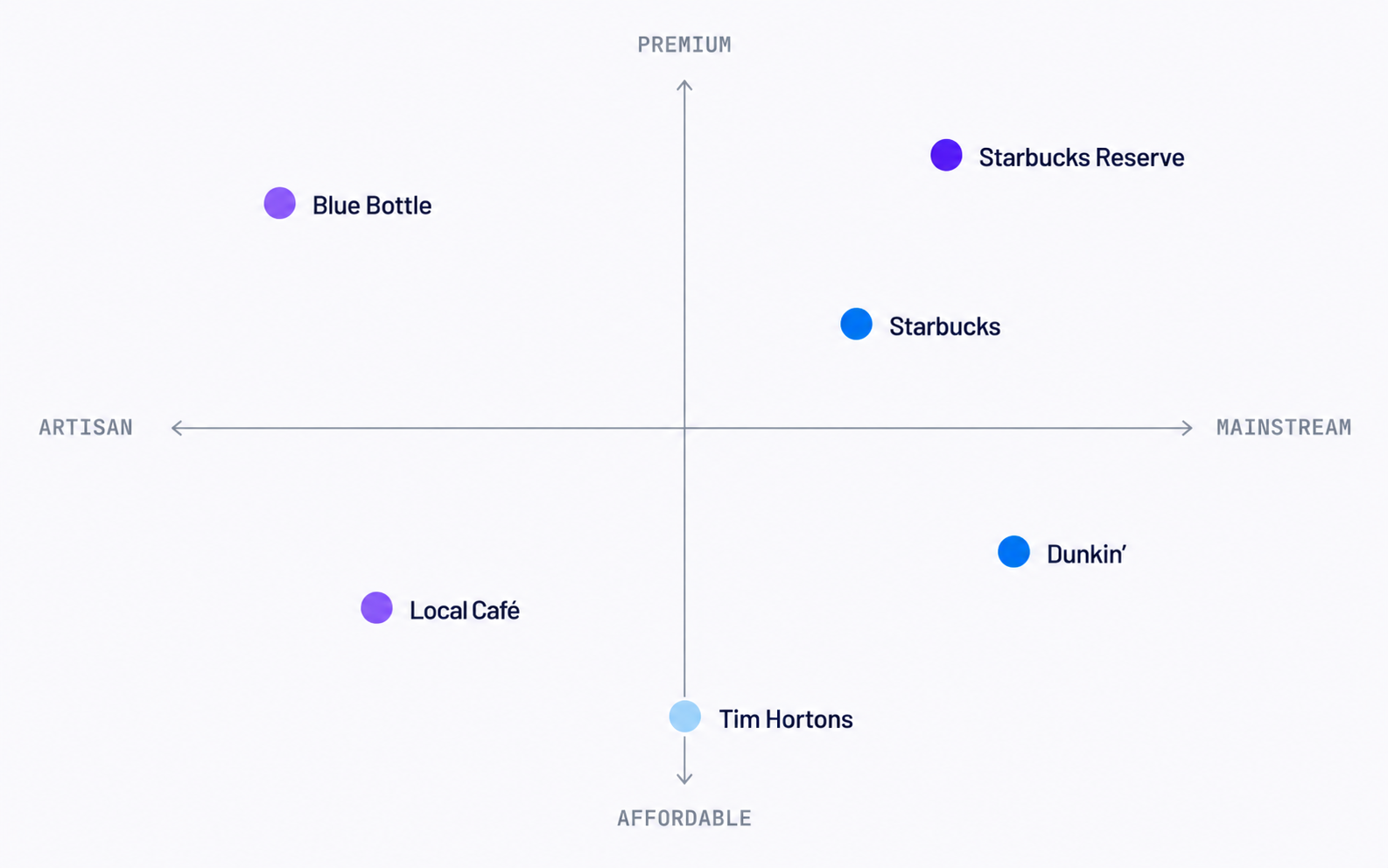
Example · coffee chains, premium vs. affordable
Brand attribute map — six coffee chains positioned on Premium ↔ Affordable and Artisan ↔ Mainstream axes.

Why it mattersReveals whether the market perceives you the way your marketing intends to position you. Starbucks Reserve exists specifically to occupy the premium quadrant.

09 · Differentiating

Brand Affinity (Co-mention Network)

What it isGraph of which other brands are mentioned in the same conversation as yours.

Example

People discussing Tesla also mention SpaceX (founder halo), Rivian (rival EV), Apple (similar buyer demographic), and Bitcoin (speculative-investment overlap). The graph reveals shared audiences.

Why it mattersIdentifies co-marketing partners, hidden competitors, and audience overlap that traditional segmentation misses.

10 · Differentiating

Net Promoter Signal

What it isNPS-equivalent score extracted from unstructured social text — no survey required.

Example · classified mentions
  • "I just got AirPods Pro and I'm telling everyone to switch" → Promoter (9–10)
  • "They're fine. Do what they should." → Passive (7–8)
  • "Battery died in 14 months. Never buying Apple audio again." → Detractor (0–6)

Aggregated across 50,000 mentions, an inferred NPS of +42 emerges.

Why it mattersSurveys are slow, biased toward respondents, and capture moment-in-time. Social NPS captures continuous, candid signal at scale.

11 · Differentiating

Topic Clusters

What it isAutomatic grouping of conversation themes via NLP.

Example · 80,000 mentions of McDonald's, broken down
  • Menu items / new launches — 32%
  • Price and value (incl. inflation complaints) — 24%
  • Service speed / drive-thru — 18%
  • App / digital ordering — 14%
  • Nostalgia and cultural moments — 8%
  • Other — 4%

Why it mattersVolume alone is meaningless; topics tell you what people are saying.

12 · Differentiating

Topic Velocity

What it isGrowth rate of each topic — surfaces what is accelerating, not just what is loud.

Example

For a personal-care conglomerate, the topic "microplastics" went from 12 mentions/week to 1,800 mentions/week over 6 weeks — 15,000% growth. By the time mainstream media picked it up, the brand had a 4-week head start to prepare a response.

Why it mattersThis is the early warning system. The biggest topics today are not usually the dangerous ones — the fastest-growing ones are.

13 · Differentiating

Topic Sentiment Matrix

What it isSentiment scored per topic, not averaged across the whole brand.

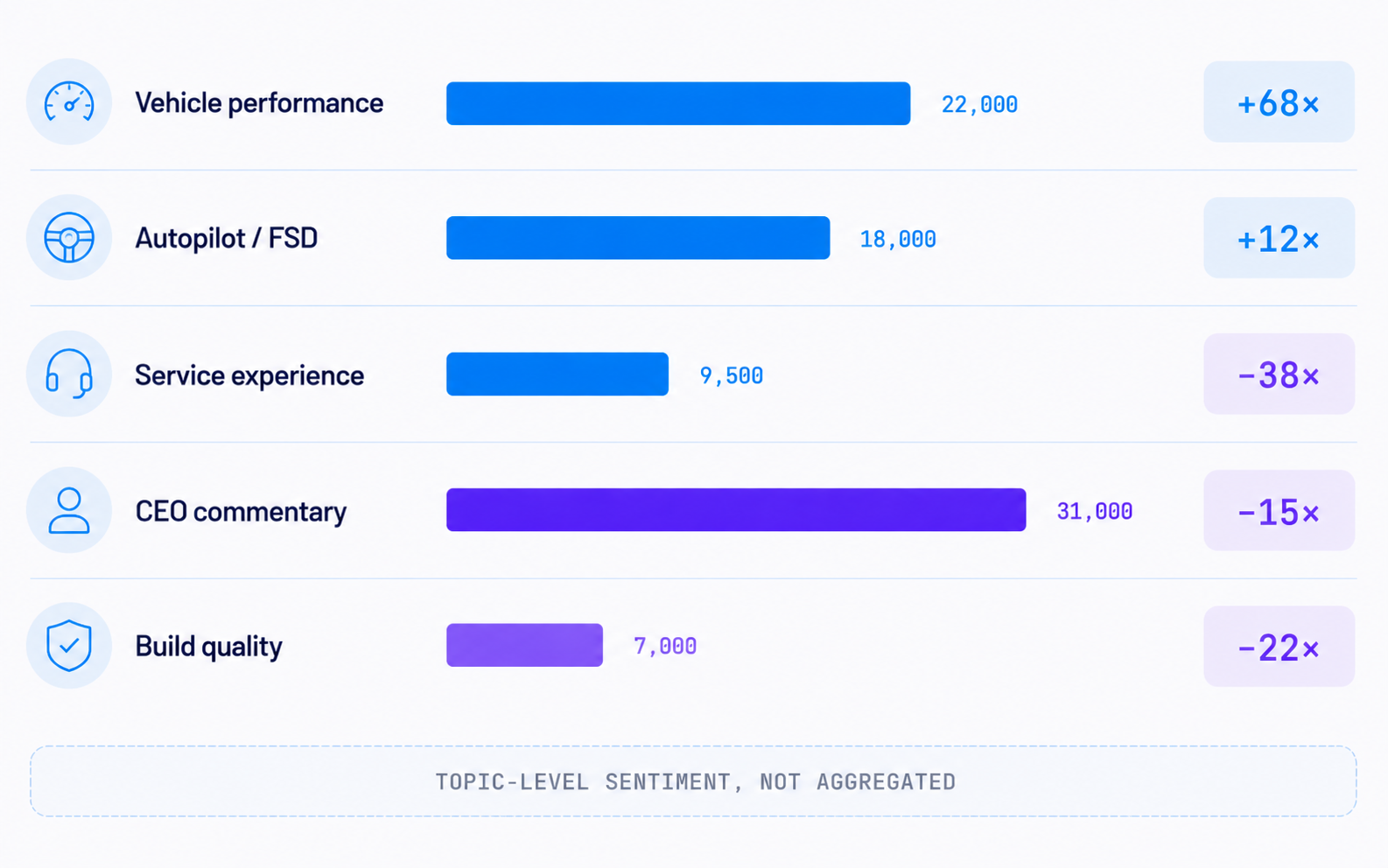
Example · Tesla, topic-level sentiment
Topic sentiment matrix — five Tesla topics shown as horizontal volume bars with sentiment chips, exposing actionable negatives (service, build quality) the aggregate hides.

Overall net sentiment looks fine averaged — but customer service and build quality have specific, actionable negative signals the aggregate hides.

Why it mattersAn average is not a diagnosis. Topic-level sentiment is where actionable problems actually live.

14 · Differentiating

Audience Persona Clusters

What it isAI segmentation of the people talking about you, based on language, interests, and behavior — not just demographics.

Example · Lululemon mentions cluster into
  • Studio committed (28%) — yoga teachers, posts about anatomy, before / after class
  • Run club community (24%) — Strava posters, race talk, gear comparisons
  • Athleisure lifestyle (31%) — coffee runs, school pickup, daily wear
  • Men's expansion newcomers (12%) — Mirror talk, golf, ABC pants discourse
  • Value skeptics (5%) — price complaints, dupe culture, Amazon alternatives

Three of these personas barely overlap. One marketing message cannot serve them all — but most brands try to.

Why it mattersReplaces survey panels and demographic guesses with what your real audience actually says.

15 · Differentiating

Influencer Tier Mapping + Authenticity

What it isClassifies influencers by reach tier, then scores each one for authentic engagement vs. inflated metrics.

Example · launch budget allocation
  • Mega (1M+) — reach 200M, ER 0.4%, authenticity 72/100
  • Macro (100K–1M) — reach 600K, ER 2.1%, authenticity 88/100
  • Micro (10K–100K) — reach 45K, ER 7.3%, authenticity 96/100
  • Nano (<10K) — 200 college students, total reach 800K, ER 12%, authenticity 99/100

For a $50K budget, 100 nanos can beat one mega on both engagement and cost-per-engaged-user — but most brands still chase celebrities.

Why it mattersTells you which influencer tier is actually efficient for your category — and which is theatre.

16 · Differentiating

Customer Journey Stage Detection

What it isClassifies each mention by where the user is in the buying journey, based on language patterns.

Example · BMW iX
  • "What is BMW iX?" → Awareness
  • "iX vs. Tesla Model X — which has better range?" → Consideration
  • "Just booked a test drive at BMW Munich tomorrow" → Purchase intent
  • "1 year with my iX, still love it. AMA." → Advocacy

Why it matters95% of mentions in most categories are awareness or advocacy noise. The 5% in consideration and intent are where marketing budget should actually go — and rarely does.

Tier 3 · Unique value

Metrics that produce decisions, not dashboards.

Anticipatory, multimodal, and action-oriented. These are the metrics that justify a budget for analytics — because they change what the business does, not just what the team knows.

17 · Unique value

Crisis Detection Score

What it isAnomaly detection across volume, sentiment intensity, virality, and emotion language. Triggers alerts before a story breaks containment.

Example · United Airlines, April 2017

The "passenger dragged off" video. Normal negative mention baseline: 200/day. Within 4 hours of the video posting, negatives surged to 18,000/hour with emotion markers like "boycott", "lawsuit", "disgusting" dominating. A Crisis Score of 94/100 would have fired within 90 minutes. The company did not issue a proper statement for 36 hours. Market cap dropped $1.4B.

Why it mattersCrisis response cost scales exponentially with delay. A 2-hour head start is worth millions.

18 · Unique value

Trend Emergence Prediction

What it isPredicts which topics will trend in N days based on early-signal patterns — small but accelerating mentions, influencer adoption curves, cross-platform spread.

Example · Stanley Cup tumblers, October 2023

Mentions were a low signal (~400/day, mostly TikTok beauty creators). The growth pattern matched prior viral product curves. Models predicted mass trend within 6 weeks. Brands that pre-ordered competing tumblers or partnered with Stanley in October captured the holiday window; those that reacted in January missed it entirely.

Why it mattersFirst-mover advantage on real trends — not chasing them after they peak.

19 · Unique value

Purchase Intent Signal

What it isIdentifies users showing buying intent by their language patterns.

Example · audio products
  • "What is a good noise-cancelling headphone under $300?" → Intent 75%
  • "Sony XM5 vs. Bose QC Ultra — help me decide" → Intent 90%
  • "Heading to Best Buy tomorrow to try the XM5" → Intent 98%

A brand can dynamically retarget the 90%+ cohort with offers — and stop wasting spend on the 5% who tweeted about headphones in passing.

Why it mattersCloses the gap between social signal and conversion. Most listening tools stop at engagement and never connect to revenue.

20 · Unique value

Competitor Gap Analysis

What it isTopics and attributes where competitors are heavily mentioned but you are not.

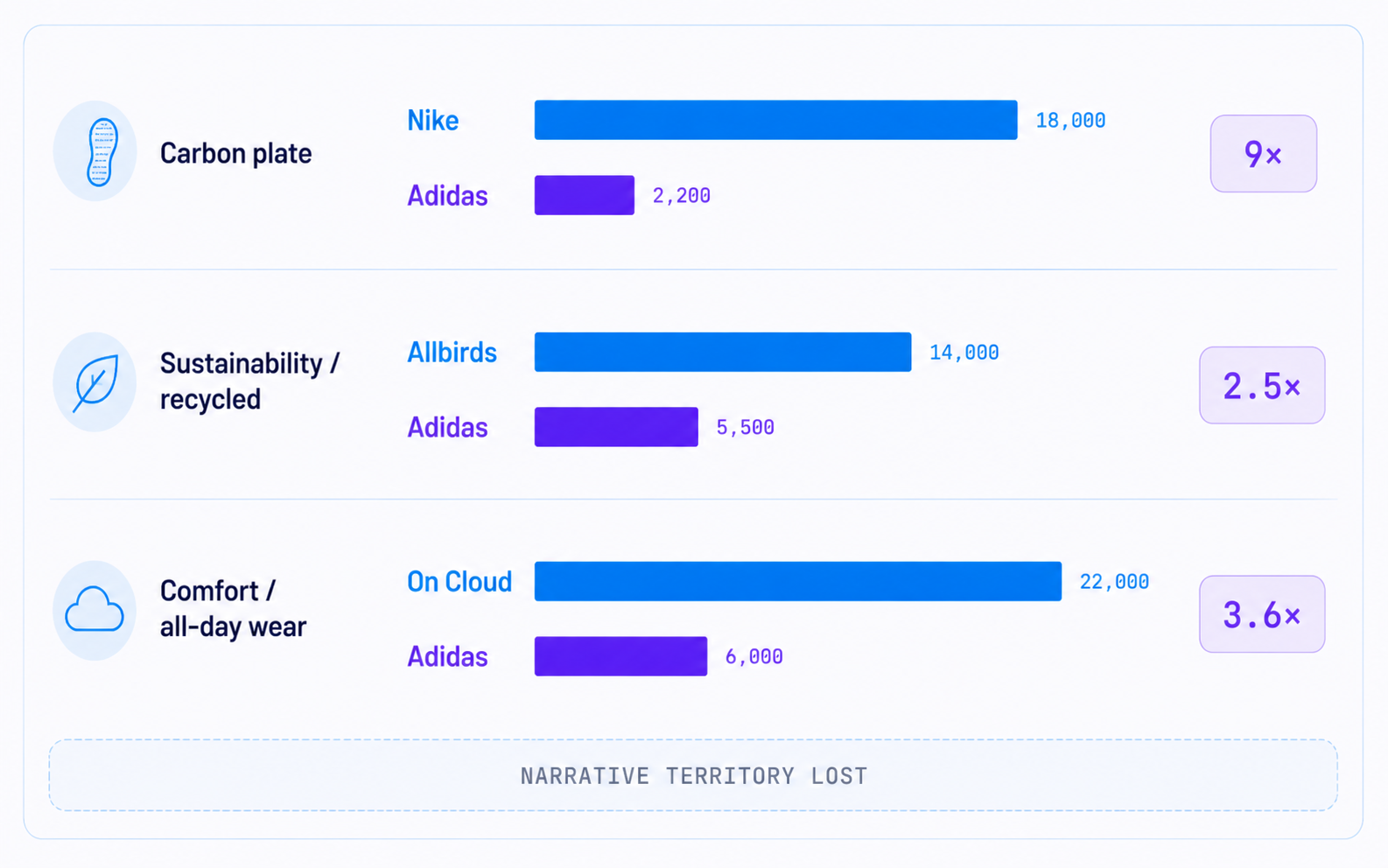
Example · athletic shoes, gaps for Adidas
Competitor gap chart — paired bars comparing category leaders vs. Adidas on Carbon plate (9×), Sustainability (2.5×), and Comfort (3.6×) gaps.

Why it mattersReveals narrative territory competitors own that you have ceded — even when you have a competing product.

21 · Unique value

Counter-Narrative Tracking

What it isTracks supporting vs. opposing narratives around a brand event in real time.

Example · Bud Light, spring 2023 boycott
  • "Boycott Bud Light" narrative — peaked at 68% of brand mentions
  • "Support Bud Light / push back on boycott" narrative — peaked at 14%
  • Neutral or other — 18%

A 5× imbalance signaled the brand could not counter the dominant narrative organically and would need a major intervention. Reading the imbalance trend daily would have informed an earlier strategic response.

Why it mattersIn every controversy there are two sides. Knowing the ratio and trajectory tells you whether to fight, pivot, or wait.

22 · Unique value

Win / Loss Analysis

What it isExtracts the reasons customers choose or reject your brand from reviews and discussions.

Example · Peloton

Why customers chose Peloton (from 12,000 mentions): instructor quality 35%, brand community 28%, build quality 18%, app ecosystem 12%, other 7%.

Why they switched away or did not buy (from 8,500 mentions): monthly subscription cost 42%, lack of strength-training depth 23%, treadmill-recall trust 15%, alternatives like Apple Fitness+ 13%, other 7%.

Why it mattersGoes directly to product strategy. Leadership now knows: do not touch instructors, fix the subscription value perception, invest in strength.

23 · Unique value

Pain Point Clustering

What it isGroups complaints, weighted by frequency × emotion intensity — so the loudest issues are not mistaken for the most important.

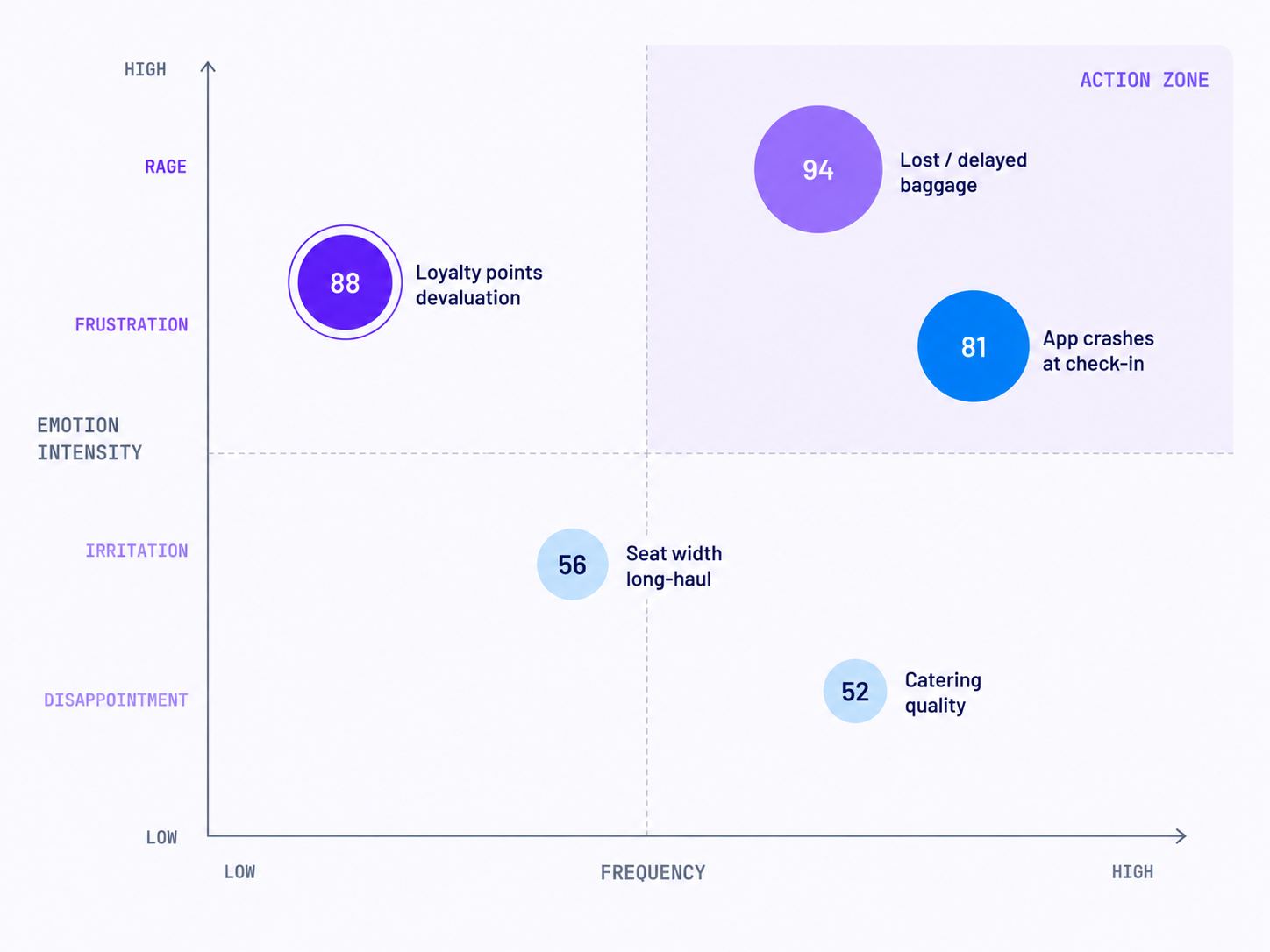
Example · major airline, last 90 days
Pain point priority matrix — frequency × emotion intensity bubble chart of five airline pain points, top-right quadrant marked as the action zone.

Frequency-only ranking would prioritize catering. Frequency × intensity reveals baggage and loyalty are the actual fires.

Why it mattersTells operations and product where to deploy fix-it budget — to the highest-emotion, not the highest-count, problem.

24 · Unique value

Content Performance DNA

What it isReverse-engineers what your top-performing content has in common.

Example · decoding Duolingo's top 20 TikToks
  • Length — 7–11 seconds (not 30–60)
  • Posting time — 19:00–22:00 local
  • Format — mascot reaction to trending audio
  • Tone — chaotic, self-deprecating, never educational
  • Hook structure — shows result first, reveals language tie-in last
  • Captions — under 40 characters, one emoji maximum

A content template emerges. Replicable, not luck.

Why it mattersMost brands review top posts subjectively — "I think it worked because…". DNA analysis is empirical.

25 · Unique value

Optimal Engagement Window

What it isWhen your specific audience is most active and responsive.

Example · LEGO, three sharply different audiences
  • AFOLs (Adult Fans of LEGO) — 21:00–24:00 weekdays (after kids in bed)
  • Parents shopping for kids — 12:00–14:00 weekdays (lunch break), 19:00 Sundays
  • Kids on YouTube / TikTok — 16:00–18:00 weekdays, all-day weekends

Posting MOC builder competition content at 16:00 misses AFOLs entirely.

Why it mattersGeneric best-time-to-post guides do not reflect your audience.

26 · Unique value

Visual Brand Presence (Multimodal)

What it isHow often your brand appears in images and videos that do not mention you in text. Requires computer vision — text-only tools cannot see this.

Example

In 30 days of Instagram, the Coca-Cola logo appears in 240,000 user-posted images without "@cocacola" or "#cocacola" tags. None of these surface in traditional listening tools — yet they represent real brand exposure equal to 4× the tagged content.

Why it mattersMost brand exposure on social is visual and untagged. Ignoring it underestimates true reach by 5–10×.

27 · Unique value

Logo / Product Detection in UGC

What it isComputer vision identifies your product in user-generated content — for reposts, brand-ambassador discovery, and counterfeit detection.

Example · two high-value use cases
  • Reposts — a skincare brand identifies 800 unsponsored routine TikToks showing its bottle. 50 get reached out for permission; 12 become organic ambassadors.
  • Counterfeit detection — a luxury house flags 2,000 images per month with logo proportions or stitching patterns inconsistent with authentic product. Legal acts.

Why it mattersTwo distinct, high-value use cases. Neither is possible with text-only listening.

28 · Unique value

Video Content Themes

What it isExtracts themes from video content — visual, audio, on-screen text — not just the caption.

Example · a TikTok with caption "GRWM" and no brand tags
  • Visible products — Rare Beauty blush (12s), Charlotte Tilbury lipstick (18s), Drunk Elephant serum (4s)
  • Spoken mentions — "this Rare blush is everything"
  • Themes — clean girl aesthetic, minimalist morning routine, late-twenties demographic

For Rare Beauty, this surfaces as 24 seconds of authentic positive exposure — invisible to text-only tools.

Why it matters60%+ of social content is now video. A text-only listening tool sees less than half the conversation.

Tier 3 produces decisions, not dashboards. Customers buy analytics to make better decisions — not to look at numbers. These twelve metrics are where Amicus Social Research is built to win.

Why Tier 3 compels buyers

The question being asked is different.

Standard tools answer descriptive questions. Tier 3 answers decision questions. The shift in question is the entire shift in value.

Standard tools answer… Amicus Tier 3 answers…
Volume "How many mentions did we get?" "Which mentions will become a crisis if not addressed in 48 hours?"
Sentiment "What is our sentiment score?" "Which specific pain point drives 60% of negative sentiment?"
Influencers "Who are the influencers?" "Which micro-influencers have authentic audience overlap with our target persona?"
Trends "What is trending?" "What will be trending in 7 days, based on early signals?"
Exposure "How many times was the brand mentioned?" "How many times did our product appear visually in UGC where no one tagged us?"
Three lines of value

What Tier 3 makes possible.

The Tier 3 metrics resolve into three propositions a customer can act on — and a buyer can justify.

01

We do not just listen — we anticipate.

Predictive metrics: crisis detection, trend prediction, purchase intent. Acting earlier is worth more than measuring more.

02

Insights, not just numbers.

Action-oriented metrics: pain point clustering, win / loss analysis, content DNA. Each one names a decision, not a count.

03

See what others cannot.

Multimodal analysis across image, video, and audio, plus customizable categories per brand. The other half of the conversation, brought into view.

Ready to see it on your brand?

Bring the framework to your data.