V. Human-in-the-Loop Workflow
This section describes the human review process that ensures quality control over ontology evolution.
5.1 Review Actions
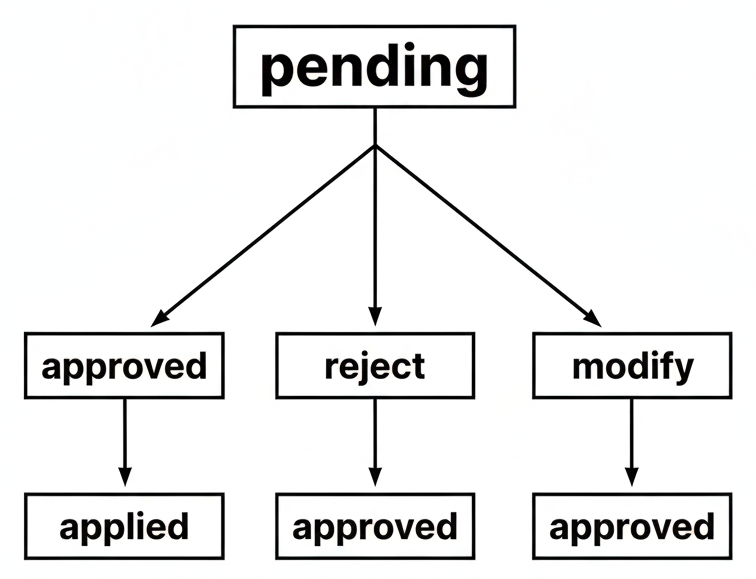
When reviewing a proposal, humans have four options:
- Approve — Accept proposal as-is for application
- Reject — Decline with feedback
- Modify — Edit and then approve
- Defer — Postpone, await more data
Each action advances the proposal through its lifecycle:
5.2 Review Interface
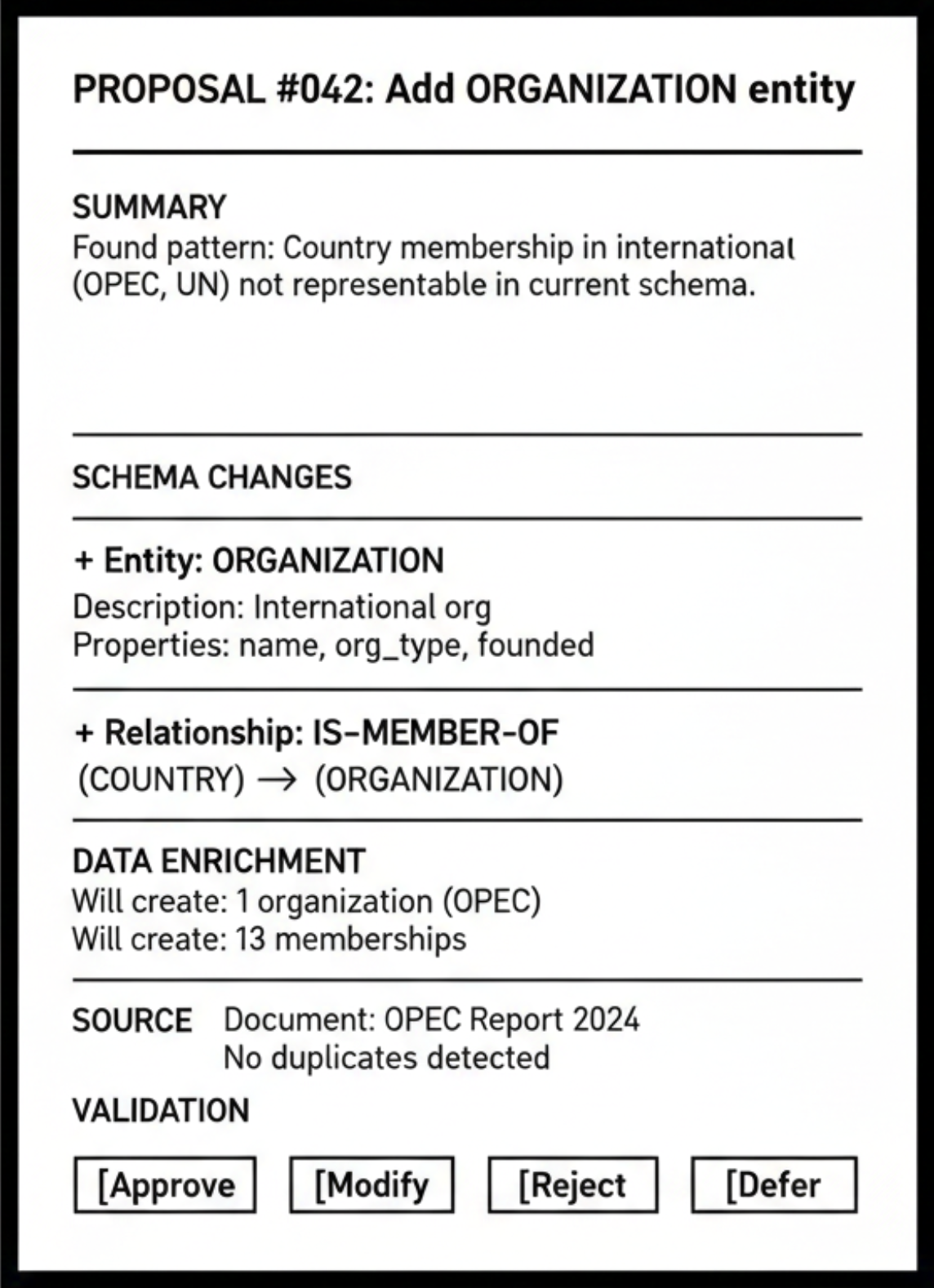
The interface presents proposals with all relevant context:
Information Sections
- Summary — Plain language explanation
- Schema changes — Detailed modifications
- Data enrichment — Instances to insert
- Source — Document provenance
- Validation — Duplicate check results
5.3 Feedback Capture
When rejecting, reviewers provide structured feedback:
- Duplicate — "Same as PARTNERS_WITH"
- Unnecessary — "Edge case, not worth adding"
- Incorrect — "OPEC is not a REGION"
- Incomplete — "Needs inverse relationship"
- Out of scope — "We don't model individuals"
This feedback can inform future proposal generation.
5.4 Batch Processing
Humans aren't always available. Proposals accumulate between review sessions. The system supports batch workflows:
- Human opens review session
- System presents priority-sorted queue
- Human reviews proposals one by one
- Approved proposals batch together
- Human confirms batch application
- System applies changes atomically
Priority Queue
Proposals are sorted by priority score based on:
- Confidence level
- Gap frequency (how often seen)
- Pending data waiting for this change
- Time in queue
High-impact, high-confidence proposals surface first.
5.5 Application Protocol
Approved proposals are applied atomically:
- Begin transaction
- Apply schema changes to meta-schema
- Insert enrichment data
- Commit transaction
- Update proposal status
- Update embeddings index
- Reprocess pending extractions
If any step fails, the entire transaction rolls back.
Pending Data Reprocessing
Documents waiting for a schema change are automatically reprocessed after approval:
Before PROP-042 approved:
  Doc A: "Qatar joined OPEC" -> PENDING
  Doc B: "UAE is OPEC member" -> PENDING

After PROP-042 approved:
  Reprocess Doc A -> Extract successfully
  Reprocess Doc B -> Extract successfully
5.6 Discussion Support
Complex proposals may require clarification. The system supports discussion threads between humans and AI:
[Human]: Why ORGANIZATION, not extending REGION?

[AI]: ORGANIZATION differs from REGION:
  - Membership is voluntary
  - Not geographically contiguous
  - Has organizational structure
  Different relationship semantics.

[Human]: What about subtypes?

[AI]: Recommend org_type property for now.
  Can evolve to subtypes if needed.

[Human]: Approved with org_type property.
5.7 Cognitive Load
The system minimizes reviewer burden through:
- Priority ordering — Important proposals first
- Pre-validation — Obvious duplicates filtered
- Clear presentation — Structured, scannable format
- Context provision — Source docs linked
- AI recommendations — Suggested actions when appropriate
The goal is efficient review sessions where humans focus on judgment calls, not information gathering.